Education is changing fast. The classrooms of today look very different from those of even a decade ago. Students no longer sit quietly in rows, copying notes from a chalkboard. They interact, explore, and create. However, many schools still rely on methods that were designed for a different era. Traditional teaching has its strengths, but it often struggles to keep students engaged or to prepare them for a complex, fast-moving world.
This is where immersive learning comes in. It shifts the focus from passive listening to active doing. Students learn by experiencing, not just by memorizing. Therefore, teachers who adopt these methods often see stronger results in both engagement and understanding. This article will walk you through practical ways to bring immersive learning into your classroom, step by step.
What Is Immersive Learning and Why Does It Matter
Immersive learning is an approach that places students inside the learning experience. Instead of reading about a concept, students interact with it. They might explore a virtual environment, solve a real-world problem, or collaborate on a simulation. The goal is to make learning feel meaningful and connected to life outside school.
Research supports this approach. Studies show that people retain about 10% of what they read but up to 75% of what they practice by doing. Additionally, immersive experiences activate multiple senses at once. This multi-sensory engagement helps the brain form stronger memories. For students who struggle with traditional methods, this can be a real game-changer.
Moreover, immersive learning builds skills that employers and universities value. Critical thinking, collaboration, creativity, and communication all develop naturally when students face open-ended challenges. Therefore, adopting these methods is not just about engagement. It is about preparing young people for the future.
Start with Storytelling and Narrative-Based Lessons
One of the simplest ways to make learning immersive is through storytelling. Humans are wired for stories. When a lesson is framed as a narrative, students pay closer attention and remember more. You do not need expensive technology to use this method. A well-crafted story costs nothing but a little planning.
For example, instead of teaching the causes of World War One as a list of facts, you could frame the lesson as a mystery. Students become investigators trying to understand how a single event led to a global conflict. They examine “evidence,” debate theories, and draw conclusions. This approach turns a passive topic into an active investigation.
Additionally, you can invite students to write their own stories around a subject. A science class might ask students to narrate a journey through the human bloodstream. A math class might challenge them to write a story where the hero must solve equations to escape a puzzle room. These activities connect curriculum content to imagination, making it stick.
Use Project-Based Learning to Solve Real Problems
Project-based learning (PBL) is one of the most effective immersive learning techniques available to educators today. In PBL, students work on extended projects that address genuine questions or challenges. These projects often span several weeks and require research, planning, teamwork, and presentation.
The key to PBL is authenticity. Students should feel that their work matters. For instance, a geography class could ask students to design a sustainable city for a growing population. A business class could challenge teams to launch a small product and track their results. When students know their work has a real audience or purpose, motivation increases dramatically.
However, PBL requires careful planning from the teacher. You need to set clear goals, provide scaffolding, and check in regularly. Without structure, open-ended projects can become overwhelming. Therefore, break the project into phases. Give students checkpoints to meet along the way. This keeps everyone on track while still allowing creative freedom.
Bring Virtual and Augmented Reality into the Classroom
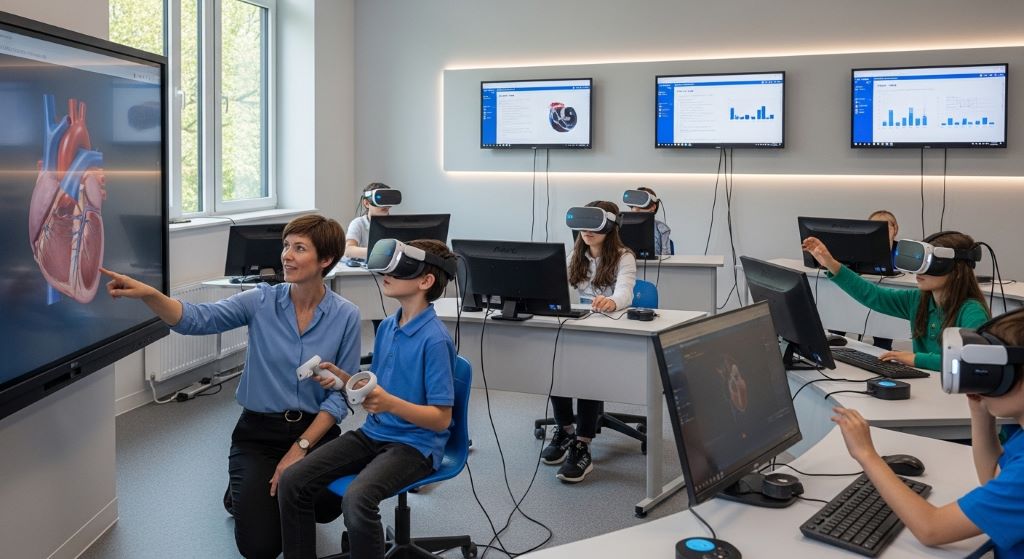
Technology has opened remarkable new doors for education. Virtual reality (VR) and augmented reality (AR) allow students to visit places and explore concepts that would otherwise be impossible. A student in a small town can walk through ancient Rome. A biology class can explore the inside of a living cell. These experiences create a sense of presence that no textbook can match.
You do not need a large budget to get started. Many schools begin with Google Cardboard headsets, which are inexpensive and compatible with most smartphones. Free platforms like Google Expeditions or CoSpaces Edu offer hundreds of virtual field trips and interactive scenes. Additionally, some AR apps let students point a tablet at a textbook image and watch it come to life in three dimensions.
Of course, technology is a tool, not a solution. The teacher’s role remains central. Before using VR or AR, set clear learning objectives. After the experience, guide a discussion that connects what students saw to the lesson goals. Therefore, the technology becomes a doorway into deeper thinking, not just a novelty.
Gamify Your Lessons to Increase Motivation
Gamification means applying game-like elements to non-game activities. Points, badges, challenges, leaderboards, and levels can all be used in a classroom setting to boost engagement. When learning feels like a game, students often work harder without even realizing it.
There are many ways to gamify a lesson. You might turn a review session into a quiz competition using platforms like Kahoot or Gimkit. You could create a classroom economy where students earn points for completing tasks and spend them on small rewards. Alternatively, you could build a semester-long narrative where students level up as they master new skills.
However, gamification works best when it supports learning, not just competition. Focus on collaboration as much as individual achievement. Reward effort and growth, not just correct answers. Additionally, make sure every student has a fair chance to succeed. When done thoughtfully, gamification can make even the most reluctant learner want to participate.
Incorporate Simulations and Role-Playing Activities
Simulations and role-playing activities put students in the shoes of someone else. They must think, speak, and make decisions from a different perspective. This kind of empathy-building exercise is both academically and socially powerful.
A history teacher might run a simulation of a United Nations debate, where each student represents a different country. A science class could simulate an ecosystem, with students playing the roles of predators, prey, and environmental factors. In a language class, students might role-play real-life conversations at a restaurant, an airport, or a job interview.
These activities require students to apply what they know in a dynamic setting. They cannot just recall facts. They must think on their feet, respond to others, and adapt their thinking. Therefore, simulations develop both content knowledge and practical communication skills at the same time.
Create Collaborative Learning Spaces
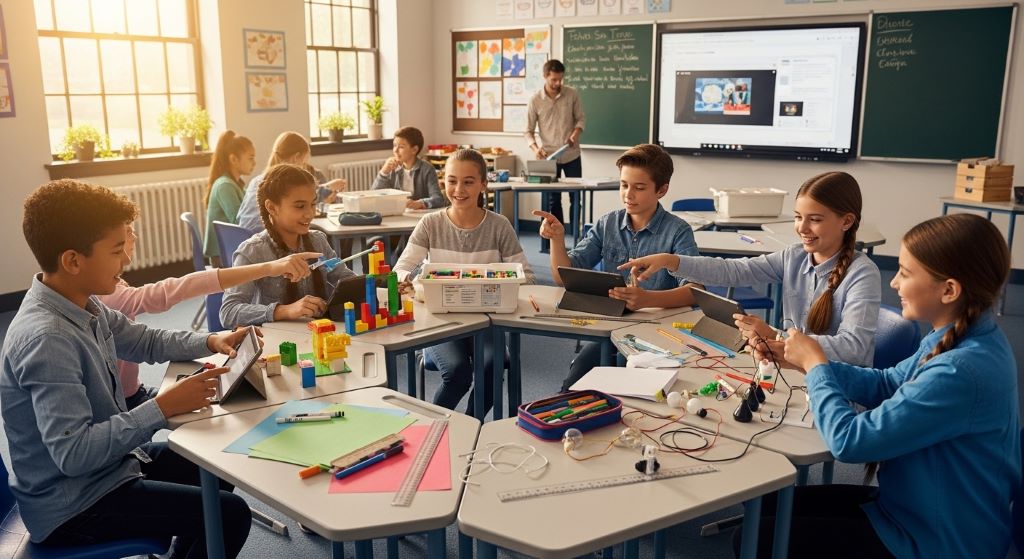
The physical environment of a classroom matters more than many teachers realize. Traditional rows of desks face forward, sending a clear message: the teacher talks, and students listen. Immersive learning, however, is built on interaction and collaboration. Therefore, rearranging the space can signal a shift in expectations.
Try grouping desks into clusters to encourage teamwork. Create a flexible layout that can change depending on the activity. If possible, add whiteboards or glass walls where students can brainstorm visibly. Soft seating areas for reading or reflection can also help. Some schools are even creating “maker spaces” where students build, tinker, and invent.
Additionally, the digital space matters too. Online tools like Padlet, Miro, and Google Jamboard allow students to collaborate visually, even when they are not in the same room. These platforms make student thinking visible to everyone, which encourages deeper discussion and peer learning.
Involve the Community and Real-World Experts
Learning does not have to stop at the classroom door. One of the most powerful ways to make education immersive is to connect students with the real world. Guest speakers, community projects, and field experiences all bring learning to life in ways that textbooks simply cannot.
Invite local professionals to speak about how they use skills from school in their daily work. A nurse can explain how biology applies at the bedside. An engineer can describe how geometry shapes every bridge she designs. These conversations help students see the purpose behind what they are learning.
Additionally, community projects give students a chance to contribute. A class might partner with a local organization to solve a real problem, such as designing a community garden or creating an awareness campaign. When students see their work making a difference, their sense of pride and ownership grows enormously.
Assess Learning Through Performance, Not Just Tests
Traditional assessments, such as multiple-choice tests, measure only a narrow slice of what students know. Immersive learning calls for a different kind of assessment. Performance-based tasks ask students to demonstrate their understanding through action.
Instead of a written test on a science unit, students might design and conduct their own experiment. Instead of an essay on a novel, they might create a podcast episode or a short film. Instead of a math quiz, they might use data to solve a real-world problem and present their findings.
These kinds of assessments are more time-consuming to design and grade. However, they give a much richer picture of what students actually understand. They also tend to feel more motivating for students. When the task is meaningful and creative, students often push themselves further than a test ever would.
Conclusion
Transforming traditional teaching does not happen overnight. It takes curiosity, planning, and a willingness to try new things. However, the rewards are well worth the effort. Immersive learning techniques, from storytelling and project-based learning to VR experiences and community connections, help students engage more deeply with content. They also build skills that last far beyond the classroom.
Start small. Choose one technique that fits your subject and your students. Reflect on what works and adjust as you go. Additionally, share your experiences with colleagues. The best educational innovations spread through conversation and collaboration. Therefore, as more teachers embrace immersive methods, the whole school culture begins to shift.
Education at its best is not about filling students with information. It is about sparking curiosity, building confidence, and connecting learning to life. Immersive learning makes that possible.
Frequently Asked Questions
What is the difference between immersive learning and traditional teaching?
Traditional teaching typically involves a teacher delivering information to passive students through lectures and textbooks. Immersive learning, on the other hand, places students at the center of active experiences, such as simulations, projects, or virtual environments, where they engage with content directly and apply it in meaningful ways.
Do I need expensive technology to use immersive learning in my classroom?
No. Many immersive learning techniques require little or no technology. Storytelling, role-playing, project-based learning, and community involvement are all highly effective and cost nothing beyond planning time. When technology is used, affordable options like free AR apps or low-cost VR headsets can provide excellent results.
How do I manage a classroom during immersive activities?
Clear expectations and structured phases are key. Break activities into manageable steps, set time limits for each phase, and establish norms for collaboration and noise levels before the activity begins. Circulating the room and checking in with groups regularly also helps keep students on task.
Can immersive learning work for all subjects and age groups?
Yes. Immersive techniques can be adapted for virtually any subject, from mathematics and science to history, language arts, and the arts. They can also be scaled for different age groups, from primary school students engaging in storytelling games to secondary students running full simulations or research projects.
How do I assess students in an immersive learning environment?
Performance-based assessments work best. These might include presentations, demonstrations, portfolios, prototypes, or multimedia projects. Rubrics help ensure that grading is fair and transparent. Additionally, reflection activities, where students write or discuss what they learned and how they approached the task, provide valuable insight into their understanding.
Related Topics:
How to Structure a Personal Education Plan for Multi-Skill Learning
How to Reduce Memorization Dependency in Formal Education