Learning new skills is one of the best investments you can make in yourself. However, trying to learn too many things at once without a plan often leads to frustration and slow progress. A personal education plan helps you stay focused, organized, and motivated. It gives your learning a clear direction.
Multi-skill learning means developing more than one skill at the same time. This approach is valuable in today’s fast-changing world. Employers want people who can do more than one thing well. Additionally, learning across different areas keeps your mind engaged and opens up new opportunities.
Therefore, having a structured personal education plan is essential. This article will guide you through every step of building one that works for your goals, your schedule, and your learning style.
What Is a Personal Education Plan and Why Does It Matter
A personal education plan, often called a PEP, is a written roadmap for your learning journey. It outlines what you want to learn, how you plan to learn it, and when you expect to reach certain milestones. Think of it as a business plan, but for your own personal growth.
Without a plan, learning can feel scattered. You might start a course today, abandon it next week, and then jump to something completely different. This pattern wastes time and builds very little real knowledge. However, when you have a structured plan, you know exactly what to focus on and why.
A personal education plan also helps you track your progress. Seeing how far you have come is one of the most powerful motivators. Furthermore, a written plan holds you accountable. It is harder to give up on a goal when you have committed it to paper or a digital document.
For multi-skill learning specifically, a plan is even more important. Managing several learning paths at once requires careful coordination. Therefore, a well-designed personal education plan becomes the tool that keeps everything balanced and moving forward.
Identifying the Skills You Want to Learn
The first step in building your personal education plan is deciding which skills to pursue. This sounds simple, but it requires honest reflection. Not every skill you find interesting is worth prioritizing right now.
Start by asking yourself a few key questions. What are your long-term career goals? What gaps exist in your current skill set? Which skills would make the biggest positive impact on your life or work? Your answers will help you narrow down a focused list.
Next, divide your chosen skills into categories. Some skills are core skills, meaning they are directly related to your main career or purpose. Others are complementary skills, which support and enhance your core abilities. Additionally, some skills may be personal interests that you pursue for enjoyment or creative fulfillment.
For example, a freelance writer might identify core skills such as advanced grammar, SEO writing, and content strategy. Complementary skills might include basic graphic design and social media management. A personal interest skill might be learning a new language.
It is important not to overwhelm your plan with too many skills at once. A realistic number for active learning at any given time is two to four skills. Therefore, choose wisely and prioritize based on impact and urgency.
Setting Clear and Achievable Learning Goals
Once you know which skills to focus on, the next step is setting clear goals for each one. Vague goals like getting better at writing are difficult to measure and easy to ignore. Instead, use the SMART framework to write goals that are specific, measurable, achievable, relevant, and time-bound.
A SMART goal for writing might look like this: complete one online copywriting course within six weeks and write five practice pieces by the end of the month. This goal tells you exactly what to do, when to do it, and how to know when you have succeeded.
Additionally, break each big goal into smaller milestones. Milestones are mini-targets that mark your progress along the way. They make large goals feel manageable. Furthermore, reaching a milestone gives you a sense of achievement that keeps you motivated to continue.
Set short-term goals that cover one to four weeks, medium-term goals that span one to three months, and long-term goals that extend six months to a year or more. This layered approach ensures that your daily actions connect to your bigger vision.
Review your goals regularly. Life changes, and so do priorities. Therefore, build in time every month to assess whether your goals still make sense and adjust them if needed.
Designing Your Learning Schedule
Understanding Your Available Time
Time is the most limited resource in any learning plan. Before you can design a schedule, you need to know how much time you actually have. Look honestly at your weekly routine. Identify pockets of time that you can dedicate to learning, whether it is 30 minutes in the morning or an hour after dinner.
Even small amounts of consistent time add up. For instance, just 30 minutes of focused learning each day amounts to over three hours per week and more than 180 hours per year. Additionally, consistency matters more than length. Learning a little every day is far more effective than studying for hours once a week.
Allocating Time Across Multiple Skills
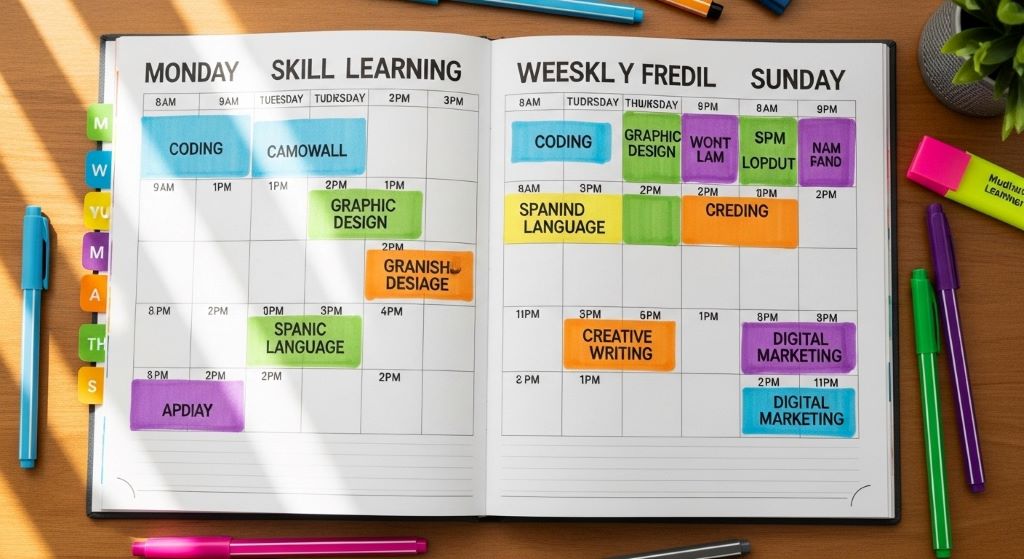
When learning more than one skill at a time, you need to decide how to split your available hours. One useful approach is time blocking, where you assign specific blocks of time to each skill in your weekly calendar.
For example, if you are learning coding and public speaking at the same time, you might dedicate Monday, Wednesday, and Friday mornings to coding practice and Tuesday and Thursday evenings to public speaking exercises. This separation helps your brain shift focus completely and prevents confusion between skill sets.
However, not all skills need equal time. Prioritize based on urgency and importance. If one skill is needed for a job promotion in three months, allocate more hours to it. The other skill can receive lighter attention during that period and be increased later.
Building in Rest and Review Time
Many learners make the mistake of filling every spare moment with new content. However, rest and review are just as important as active learning. Your brain needs time to consolidate new information. Without rest, learning becomes less efficient over time.
Schedule at least one full rest day per week where you do not engage in formal study. Additionally, include weekly review sessions of about 15 to 20 minutes to revisit what you learned. This practice, known as spaced repetition, strengthens memory and deepens understanding.
Choosing the Right Learning Resources
The quality of your resources directly affects the quality of your learning. Today, there is an abundance of learning materials available. The challenge is choosing the right ones for each skill in your plan.
Start by researching the best resources for each skill you are developing. For technical skills like coding or data analysis, structured courses on online learning platforms tend to work well. For communication skills, books, podcasts, and practice-based workshops are highly effective.
Additionally, consider a mix of learning formats. Some people learn best by watching video tutorials. Others prefer reading books or listening to audio content. Hands-on practice is often the most powerful method for skills like writing, design, or physical craft. Therefore, combine formats to keep your learning fresh and effective.
Be selective. More resources are not always better. Trying to read five books, take three courses, and watch dozens of videos on the same topic at the same time leads to information overload. Instead, choose one or two high-quality resources per skill and go deep before moving on.
Also, consider free versus paid resources. Many excellent free materials exist on YouTube, open courseware platforms, and public libraries. However, for structured learning with clear progression, paid courses often provide better organization and accountability. Balance your choices based on your budget and learning needs.
Tracking Your Progress Effectively
A personal education plan is only as useful as the tracking system behind it. Without monitoring your progress, it is easy to drift off course or lose momentum. Fortunately, tracking does not have to be complicated.
One simple method is keeping a learning journal. Each day or week, write a brief note about what you studied, what you understood, and what questions remain. Over time, your journal becomes a record of your growth and a reminder of how much you have achieved.
Another effective tool is a progress tracker spreadsheet. List each skill you are learning, the resources you are using, the goals you have set, and a column to mark completed milestones. Reviewing this tracker weekly gives you a clear picture of where you stand.
Additionally, use self-assessment regularly. After completing a unit or module, test yourself without looking at notes. Can you explain the concept clearly? Can you apply the skill in a practical situation? If the answer is yes, you are making real progress. If not, revisit the material before moving forward.
Celebrate small wins. When you reach a milestone, acknowledge it. Take a short break, treat yourself, or simply take a moment to reflect on your effort. Positive reinforcement keeps the learning process enjoyable and sustainable.
Staying Motivated Through the Learning Process
Motivation is one of the biggest challenges in self-directed learning. When there is no teacher, no deadline, and no external pressure, it is easy to procrastinate or give up when things get hard.
One powerful way to stay motivated is to connect your learning to a deeper purpose. Ask yourself why each skill matters to you. When the reason is strong, the effort required feels worthwhile. Write your reason at the top of your personal education plan as a daily reminder.
Additionally, find a learning community. Joining a group of people who are working toward similar goals creates accountability and encouragement. Online forums, study groups, and local meetups all provide this kind of support. Furthermore, explaining what you are learning to others reinforces your own understanding.
Vary your learning activities to avoid boredom. If you have been reading the same textbook for weeks, switch to a video series, a podcast, or a hands-on project for a while. Novelty keeps your brain engaged and prevents burnout.
Finally, be kind to yourself when progress feels slow. Learning is not always linear. There will be days when nothing seems to click. However, consistent effort over time always produces results. Therefore, focus on showing up regularly rather than only on outcomes.
Reviewing and Updating Your Education Plan
A personal education plan is not a fixed document. It should evolve as you grow, as your goals change, and as you gain new information about what works for you.
Schedule a formal review of your plan every one to three months. During this review, ask yourself several important questions. Have you reached the milestones you set? Are the resources you chose effective? Do your goals still align with your current priorities? Is the amount of time you are dedicating realistic?
Based on your answers, update the plan accordingly. You might add a new skill, remove one that is no longer relevant, or adjust your schedule to better fit your life. Additionally, as you advance in a skill, your learning resources will need to evolve. Beginner materials are no longer useful once you have moved to an intermediate level.
Treat each review as an opportunity rather than a chore. It is a chance to reflect on your progress, realign your efforts, and recommit to your personal growth. Furthermore, the act of regularly reviewing your plan builds self-awareness and improves your ability to learn more efficiently over time.
Conclusion
Structuring a personal education plan for multi-skill learning is one of the smartest things you can do for your personal and professional development. It brings clarity to what you want to learn, order to how you approach it, and purpose to the time you invest.
The process begins with identifying meaningful skills and setting SMART goals for each one. From there, you design a realistic schedule, choose the right resources, and build a system for tracking your progress. Additionally, staying motivated through community, purpose, and variety keeps the learning journey enjoyable and sustainable.
However, the most important element is consistency. Even a simple plan followed consistently will produce better results than a perfect plan that is rarely used. Therefore, start with what you have, keep it practical, and adjust as you go.
Your education is one of the few things that can never be taken from you. Invest in it thoughtfully, structure it wisely, and commit to it daily. The skills you build today will shape the opportunities available to you tomorrow.
Frequently Asked Questions
1. How many skills should I include in my personal education plan at one time?
It is generally best to focus on two to four skills at a time. Learning too many skills simultaneously spreads your attention too thin and slows progress across all areas. Therefore, prioritize based on your current goals and urgency, and add new skills only after you have made solid progress on your existing ones.
2. How long should a personal education plan cover?
A personal education plan can cover any time period, but a common structure is a 12-month plan broken into quarterly milestones. This length is long enough to achieve meaningful progress and short enough to stay relevant and motivating. However, you should review and update your plan every one to three months to keep it aligned with your evolving goals.
3. What is the best way to balance multi-skill learning with a busy schedule?
Time blocking is one of the most effective strategies for busy learners. Assign specific days or time slots to each skill so that your learning is protected and consistent. Additionally, even 20 to 30 minutes of focused daily practice is highly effective when done consistently. The key is treating learning time as a non-negotiable part of your routine.
4. How do I know if my personal education plan is working?
You will know your plan is working if you are consistently reaching the milestones you set, if your skill level is visibly improving, and if you feel motivated and engaged. Track your progress regularly using a journal or spreadsheet. If progress has stalled, review your goals, resources, and schedule and make thoughtful adjustments where needed.
5. Can I create a personal education plan without any formal education background?
Absolutely. A personal education plan is designed for self-directed learners of all backgrounds. You do not need any formal qualifications to build one. All you need is a clear sense of what you want to learn, a realistic schedule, and the commitment to follow through. Furthermore, many of the most successful learners in the world are entirely self-taught using well-structured personal plans.
Related Topics:
Post-Exam Strategies for Student Reflection: Boosting Growth and Learning
How can parents support a child with dyscalculia in math?