Church law vs state law shapes how beliefs, rights, and daily life interact in every society. Understanding the interaction between canon law and civil law helps readers see where religious freedom ends, where state authority begins, and how both can coexist without constant conflict. This guide explains the key differences, real-world examples, and common questions in a clear, readable way that matches user intent and SEO best practices.
What church law means
Church law, often called canon law in many Christian traditions, is the internal legal system of a church that regulates its members, institutions, and religious life. It covers topics such as sacraments, church membership, discipline, governance structures, and the roles of clergy and laity.
In the Catholic Church, for example, canon law is organized in a formal code and applied through church courts known as tribunals. Similar systems exist in Orthodox and Anglican churches, though each community has its own rules, procedures, and authorities.
What state law means
State law (or civil law) is created and enforced by governments to regulate public order, rights, and obligations within a territory. It applies to everyone in the jurisdiction, regardless of religious belief, and includes areas like criminal law, contracts, property, family law, and constitutional protections.
Modern constitutional states usually claim a monopoly on coercive power: they set the binding rules for courts, police, and administrative agencies. Even when they respect religious freedom, they still expect churches and religious groups to operate within the limits of civil law.
Core idea: church law vs state law
The phrase “church law vs state law” describes the relationship between two different sources of authority: religious communities and political governments. Church law is grounded in theology and spiritual authority, while state law is grounded in constitutions, parliaments, and secular legal principles.
Conflicts arise when both systems claim to regulate the same issue, such as marriage, education, employment, or moral behavior. In most modern systems, the state has the final say in public legal disputes, but churches retain autonomy over internal religious matters.
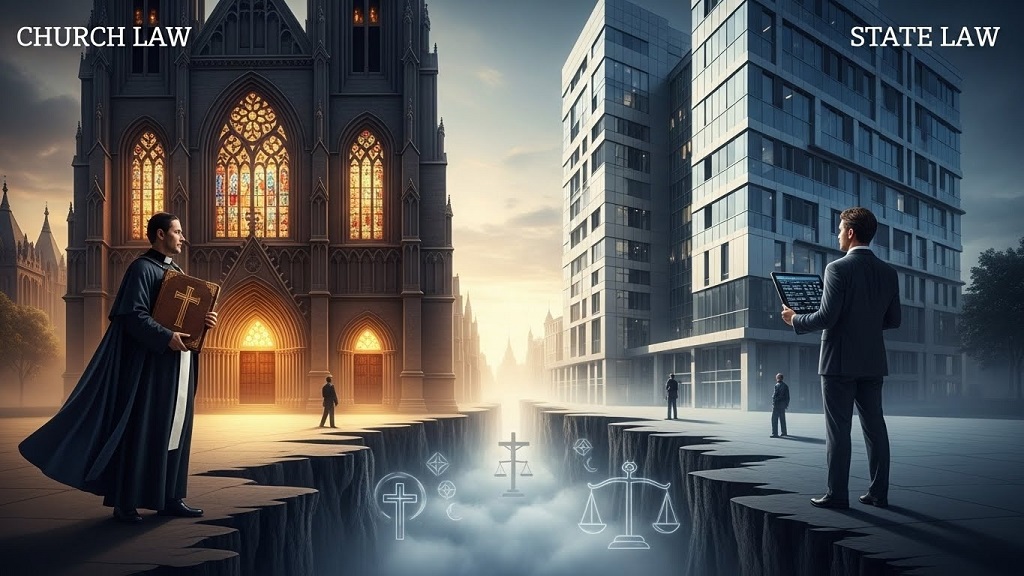
Key differences at a glance
Here is a simple comparison to make the interaction between canon law and civil law clearer.
| Dimension | Church law (canon law) | State law (civil law) |
|---|---|---|
| Source of authority | Religious doctrine, tradition, and ecclesiastical leadership. | Constitution, legislation, and judicial decisions. |
| Who it governs | Members and institutions of a particular church. | All persons and entities within the state’s territory. |
| Main purpose | Spiritual welfare, sacramental order, internal discipline. | Public order, rights protection, dispute resolution. |
| Enforcement | Church courts and religious authorities, using spiritual sanctions. | State courts, police, and agencies, using legal penalties. |
| Legal consequences | Loss of office, restrictions on ministry, exclusion from sacraments. | Fines, damages, imprisonment, loss of civil rights. |
This table shows that church law and civil law operate on different levels, even when they touch similar life events.
Historical background of religious law vs state law
For many centuries in Europe, church and state were closely intertwined, especially in countries where a particular church was officially established. Bishops had legal roles, church courts handled moral and family matters, and rulers often claimed divine authority for their power.
The Reformation and later Enlightenment thought pushed societies toward a clearer distinction between political and religious power. Over time, many constitutions adopted ideas like freedom of religion and non-establishment, limiting how far the state could enforce religious rules and how far churches could control political decisions.
Separation and cooperation in modern systems
Modern legal systems handle church law vs state law in different ways, but two broad models often appear.
-
Separation model: The state is neutral toward religion, does not endorse a particular church, and keeps state institutions officially secular. Examples include the United States and France, though they apply separation in different ways.
-
Cooperation or concordat model: The state recognizes certain churches in law and sometimes signs treaties or agreements with them, for example on marriage, education, or chaplaincy.
Even in separation systems, the state still has to understand church law so that it can respect religious freedom while enforcing civil norms.
How canon law and civil law interact in practice
The interaction between canon law and civil law becomes most visible in everyday areas like marriage, property, employment, and religious freedom.
Marriage and family life
Many Christian traditions treat marriage as both a religious and a human reality. In canon law, marriage is often described as a sacred covenant with specific conditions for validity and dissolution. In civil law, marriage is a legal status affecting taxes, property, inheritance, and parental rights.
This creates several practical scenarios:
-
A couple may marry in church and then register the marriage with civil authorities to make it legally valid in the state.
-
A couple may obtain a civil divorce, but their church might still treat them as married until a church tribunal grants an annulment or similar declaration.
In such situations, religious law vs state law does not always directly clash but can produce tension for believers who want to satisfy both systems.
Property and institutions
Churches own property and run schools, hospitals, and charities that operate under state frameworks, such as corporate and tax law. Civil law deals with ownership, land registration, liability, and contracts, while church law often decides internally who may administer and use church assets.
The state’s concern is that religious organizations meet public law requirements, like safety, employment law, and transparency, not how they organize internal authority.
Employment and internal autonomy
When clergy or church employees work in roles that also have a public dimension, the interaction between canon law and civil law can become sensitive. Courts in several countries recognize a degree of “internal autonomy” for religious bodies in matters like doctrine, worship, and the appointment of ministers.
At the same time, states may still apply general labor and anti-discrimination laws, especially in roles that do not involve core religious functions. The balance between respecting religious freedom and enforcing equal treatment is a recurring legal and political debate.
Church law and civil law in different countries
The exact shape of church law vs state law depends heavily on national history and constitutional design.
-
United States: The First Amendment bars the government from establishing a religion and protects free exercise, creating a strong formal separation between church and state. Courts generally avoid deciding internal religious disputes but will apply civil law where contracts, property, or public duties are involved.
-
United Kingdom: The Church of England is established in law, and some of its structures are integrated into the constitutional system, but there is still broad religious freedom and pluralism.
-
France: The doctrine of laïcité emphasizes a secular state and keeps religion largely out of public institutions, especially schools and government offices.
-
Other countries: Some systems, such as those in parts of Europe or Latin America, use concordats or agreements between the state and churches to regulate education, marriage recognition, and chaplaincy services.
These models show that religious law vs state law is not handled in a single universal way but adapted to cultural and historical contexts.
Why this topic matters for you
Understanding church law and civil law is useful for several groups.
-
Believers: It clarifies when an issue is a matter of conscience and church discipline versus when it carries legal consequences from the state.
-
Lawyers and policymakers: It helps craft laws and policies that respect religious freedom while protecting the rights of all citizens.
-
Educators and students: It provides context for debates about school prayer, religious symbols, or public funding of religious services.
Knowing how canon law interacts with civil legal systems also helps avoid misunderstandings, such as assuming that religious rules automatically have civil force or that civil decisions can rewrite doctrine.
FAQs on church law vs state law
1. Can church law override state law?
In modern constitutional systems, church law cannot override state law in public legal matters such as crime, taxation, or civil rights. Churches retain internal authority over doctrine, worship, and membership, but civil courts have the final say in disputes involving legal rights and obligations.
2. Does the state ever enforce canon law?
States usually do not directly enforce canon law, but they may recognize the civil effects of religious acts, such as registering religious marriages or acknowledging church charities under tax law. The state’s enforcement power comes from civil statutes, not from the religious rules themselves.
3. What happens when civil law conflicts with religious beliefs?
When civil law and religious beliefs conflict, individuals and institutions often rely on constitutional protections for freedom of religion to seek exemptions or accommodations. Courts then balance religious liberty against other public interests, such as equality, safety, or the rights of third parties.
4. Is canon law the same across all Christian churches?
No. The Catholic Church has a highly developed code of canon law, while Orthodox, Anglican, and other churches have their own legal traditions and structures. Even when they share similar theological roots, the details of procedures, courts, and sanctions differ.
5. Why do governments need to understand church law?
Governments and courts need a basic understanding of church law to handle cases involving religious institutions fairly, especially in charity law, education, employment, and property disputes. This knowledge allows civil authorities to respect religious autonomy without giving churches an unchecked legal sphere.
Clear call to action
If you manage a church, school, or faith-based organization, consider reviewing your policies to see how well they align with both your internal church law and the civil laws in your country. For detailed issues—such as employment contracts, property ownership, or marriage procedures—consult both a legal professional familiar with state law and, where relevant, an expert in canon law or your own religious legal tradition.
For bloggers, ministry leaders, and educators, use this article as a starting point for teaching about church law vs state law, and then adapt the examples to your local context to give your audience clear, practical guidance.
Related Topics: Top AI Tools for Higher Education in 2025: Transforming Teaching and Learning
Related Topics: How to Integrate AI Tutoring in Modern Classrooms